
 by

The Haryana real estate market could be heading towards an important change, especially for people who own residential plots or are planning to invest in independent floors. The state government has proposed amendments to the Haryana Building Code, 2017, which could allow significantly more construction on residential plots.
Under the proposed changes, the maximum permissible Floor Area Ratio (FAR) could increase to 264% for residential plots measuring up to 250 square metres. For larger plots measuring up to 1,000 square metres, the proposed maximum FAR would be 240%.
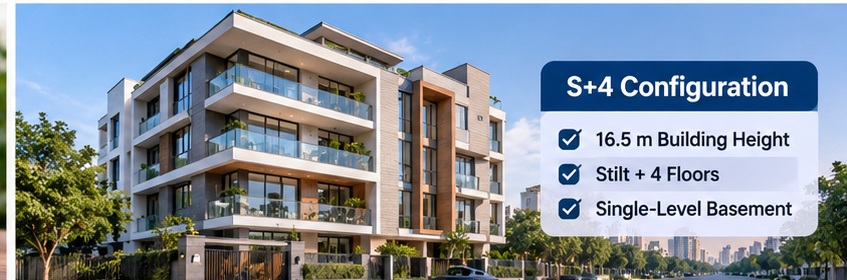
The proposal also retains the maximum building height of 16.5 metres, along with provisions for a stilt-plus-four-floor (S+4) configuration and a single-level basement.
For homeowners, this could mean more flexibility when planning to expand or rebuild their properties. For real estate developers and investors, it may open up additional opportunities in the plotted residential segment.
Let’s understand what these proposed changes mean and how they could influence the Haryana property market.
What Is the New FAR Proposal in Haryana?
The Directorate of Town and Country Planning (DTCP), Haryana, issued a public notice on November 2, 2026, inviting objections and suggestions regarding the proposed amendments to the Haryana Building Code, 2017.
One of the biggest highlights of this proposal is the increase in maximum permissible FAR for residential plots.
FAR, or Floor Area Ratio, determines how much total floor space can be constructed on a particular plot of land compared to its total area.
For example, a 100-square-metre plot with a FAR of 200% could potentially accommodate 200 square metres of total floor area across its permitted floors, subject to other building regulations.
Under the new proposal, eligible residential plot owners could get access to additional construction potential through purchasable FAR, subject to applicable charges and approvals.
This could make better use of existing residential land without increasing the overall permitted building height.
Proposed FAR Limits for Residential Plots in Haryana
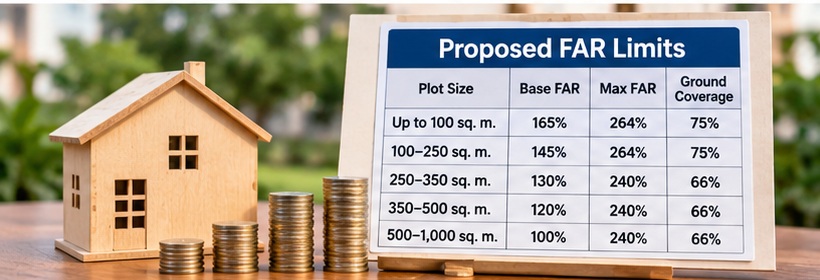
The proposed amendments divide residential plots into five categories based on their size. Each category has a different base FAR, maximum permissible FAR and ground coverage limit.
Here is a breakdown of the proposed regulations:
| Residential Plot Size | Proposed Base FAR | Maximum Permissible FAR | Ground Coverage |
|---|---|---|---|
| Up to 100 sq. m. | 165% | 264% | 75% |
| 100–250 sq. m. | 145% | 264% | 75% |
| 250–350 sq. m. | 130% | 240% | 66% |
| 350–500 sq. m. | 120% | 240% | 66% |
| 500–1,000 sq. m. | 100% | 240% | 66% |
The maximum permissible FAR includes additional purchasable FAR. Therefore, property owners may need to pay the applicable charges to utilise the full construction potential.
These proposed limits could give residential plot owners more flexibility, particularly those looking to construct additional independent floors or redevelop older properties.
More Construction Space Without Increasing Building Height
One interesting aspect of the proposal is that Haryana is looking to increase construction potential while retaining the existing maximum building height of 16.5 metres.
The proposed framework includes:
- Maximum building height of 16.5 metres.
- Provision for a stilt-plus-four-floor (S+4) configuration.
- Single-level basement provision across all five plot categories.
- 75% ground coverage for plots up to 250 square metres.
- 66% ground coverage for plots above 250 square metres.
This means the additional construction potential would primarily come from the revised FAR provisions rather than an increase in the permitted building height.
However, the proposed S+4 provision should not be interpreted as automatic permission to construct four floors. Applicable court orders, zoning requirements and departmental approvals must also be considered.
Example: How Much Can You Build on a 300 Sq. Yard Plot?
To understand the potential impact of these proposed changes, let’s take an example of a residential plot measuring 300 square yards.
A 300-square-yard plot is approximately 251 square metres, which places it in the 250–350 square metre category.
Under the proposed regulations:
- Plot Size: 300 square yards
- Ground Coverage: 66%
- Base FAR: 130%
- Maximum Permissible FAR: 240%
- Maximum Building Height: 16.5 metres
At the proposed base FAR of 130%, the total construction potential would be approximately 3,510 sq. ft.
However, with the maximum permissible FAR of 240%, including additional purchasable FAR, the potential construction area could increase to approximately 6,480 sq. ft.
That means property owners could potentially get an additional 2,970 sq. ft. of construction area, subject to applicable charges, building regulations and necessary approvals.
For someone planning to rebuild an old house or explore independent-floor development, this additional construction potential could make a considerable difference.
How Could These Changes Benefit Homebuyers and Property Owners?
The proposed FAR amendments could bring several opportunities for different segments of the residential real estate market.
1. More Space for Existing Homeowners
People who already own residential plots may get additional construction flexibility. This could be particularly useful for families looking to expand their homes or accommodate multiple generations under one roof.
2. Better Redevelopment Opportunities
Older independent houses in established residential areas may become more attractive for redevelopment. With additional permissible construction area, property owners could explore rebuilding options instead of continuing with outdated structures.
3. More Independent Floor Options
The proposed changes could create additional opportunities for developers interested in independent-floor construction. Depending on the final regulations, this may contribute to a wider range of residential options for buyers.
4. Better Utilisation of Residential Land
In growing cities such as Gurugram and other urban centres of Haryana, efficient land utilisation is becoming increasingly important. Higher permissible FAR could help property owners make better use of their existing residential plots.

What About the Existing S+4 Floor Policy?
The proposed amendments also mention the S+4 configuration, which has been an important topic in Haryana’s residential real estate sector.
However, there is an important legal consideration, particularly for property owners in Gurugram.
The Punjab and Haryana High Court passed an interim order in April 2026 restraining the implementation of the S+4 policy in Gurugram. Subsequent official records have also referred to restrictions on related approvals.
Therefore, even though the proposed building-code amendments mention S+4 construction, property owners should not assume that they can immediately start constructing stilt-plus-four floors.
The applicable court directions, DTCP guidelines and final government notifications will determine what can actually be approved.
What Could Be the Challenges of Increasing FAR?
While higher FAR can create more construction opportunities, it also brings some important questions about urban infrastructure.
Increasing the number of residential floors and potential households within existing colonies could put additional pressure on:
- Internal roads and traffic movement.
- Parking facilities.
- Water supply and drainage systems.
- Sewerage infrastructure.
- Electricity distribution and other essential services.
For any successful urban development policy, additional construction potential should go hand in hand with adequate infrastructure planning.
This is particularly important for established residential colonies where existing infrastructure may already be under pressure.
December 1, 2026: Last Date to Submit Suggestions and Objections
The Directorate of Town and Country Planning, Haryana, has invited feedback from the general public and other stakeholders on the proposed amendments.
The public notice was issued on November 2, 2026, and the last date for submitting objections and suggestions is December 1, 2026.
The feedback process will allow residents, property owners, developers and other stakeholders to share their views before the proposed amendments move forward.
The final implementation will depend on the applicable government notification and regulatory process.
What Does This Mean for the Future of Haryana’s Real Estate Market?
Haryana’s proposed FAR amendments could become an important development for the residential real estate sector.
For existing plot owners, the proposal may provide an opportunity to explore additional construction and redevelopment. For developers, it could create new possibilities in the independent-floor segment. Homebuyers may also benefit from a wider range of housing options, depending on how the final rules are implemented.

However, buyers and investors should carefully evaluate the applicable FAR, building permissions, zoning restrictions, development charges and legal status of any property before making an investment decision.
The key takeaway is simple: Haryana is exploring ways to provide more construction flexibility on residential plots while retaining the existing height restrictions.
If implemented in its proposed form, these changes could bring a new dimension to residential development across the state.
Stay connected with Ethos Pro Realtors for the latest real estate news, property updates and market developments to make more informed property decisions.




Join The Discussion